Thursday, December 10, 2009

Why we need Judith Binney

Judith Binney is not one of New Zealand's best-known historians. She is not a bestseller like Michael King, and she has not written about contemporary social and political issues in the way that King did in the '80s and '90s and Paul Moon has frequently done in recent years. Television producers do not call and ask her to join those hastily-assembled 'panels of experts' that provide answers to 'burning questions' on public affairs programmes.

Nor is Binney a particularly prolific historian. While scholars like Moon and Jamie Belich seem intent on filling a whole wing of a library with their work, Binney has averaged one book a decade during her career.

Despite her relatively low public profile and her relatively small bibliography, Binney has exercised more influence over New Zealand's intellectual and arts communities than any other contemporary historian. She is revered by anthropologists and sociologists as well as by historians, and her work has energised poets, painters, and film-makers, not to mention museum curators. The news that Binney is lying in a coma in an Auckland hospital after being hit by a truck has upset hundreds of people who have never known her personally, but who owe her a profound intellectual and imaginative debt.

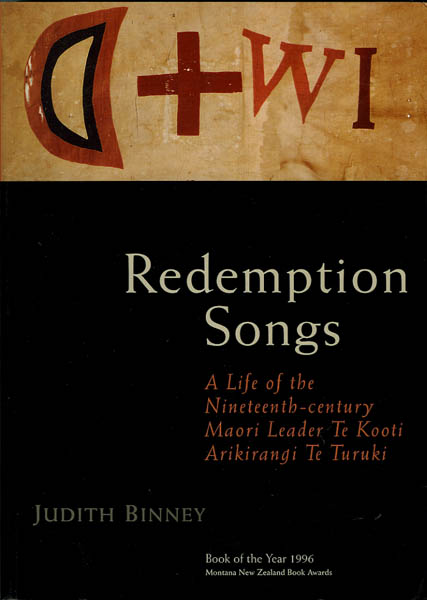
Binney's reputation rests primarily on Redemption Songs, the seven hundred page biography of Te Kooti Arikirangi Te Turuki she published in 1995. Ever since he escaped from imprisonment on Chatham Island in 1868 with the group of followers who would become his army, Te Kooti has been famous as a prophet and a rebel. Redemption Songs showed that he was also a theologian, a politician, a songwriter, an architect, and - for most of his life - a man of peace.

Binney's masterpiece was greeted by awed reviews, won the best book prize at the Montana Awards in 1996, and is unlikely to go out of print for a very long time. Redemption Songs is an unparalleled portrait of the most remarkable man ever to live on these islands, but it has extrinsic as well as intrinsic importance. It would not be going too far to say that the methodology which Binney brings to the book has the potential to change the way New Zealanders think and write about their past and about their identities.

I can perhaps best explain Binney's methodological breakthrough in Redemption Songs by taking a detour into my own current research interests - this is a blog post, not an academic monograph, so a little self-indulgence is surely permissible - and relating a story I recently heard about a couple of Binney's predecessors, Kendrick Smithyman and Keith Sinclair. Smithyman and Sinclair grew up together in the working class Auckland suburb of Point Chevalier during the Depression, and developed a love for New Zealand history. In the decades after World War Two, Sinclair became New Zealand's pre-eminent historian, while Smithyman slowly accumulated a reputation as a poet.

According to my informant, who knew both men well, neither the historian nor the poet was entirely happy with his achievement. Sinclair felt that books like his Penguin History of New Zealand might be a little 'dry', preoccupied as they were with economic trends and the personnel of governments. Sinclair wrote some middling poetry in his spare time, and he envied the imaginative leaps and bizarre details that his friend Smithyman crammed into his verses about the landscape and history of the North Island.

For his part, Smithyman could be a little jealous of his old friend's achievements as a historian. Smithyman did just as much reading of historical materials as Sinclair, poring over old newspapers, nineteenth century diaries, and dull amateur histories of Northland hamlets. At various times in his life Smithyman attempted to turn his research into essays, but he struggled to build a narrative and a set of conclusions out of the data he had hoarded. Smithyman loved to retell strange stories, ponder unpopular, half-forgotten ideas, and celebrate obscure people and places. His fascinations give his poems lustre, but leave his historical essays sinking under a weight of undifferentiated detail.

Atua Wera, Smithyman's posthumously-published epic poem of nineteenth century Hokianga, is a compendium of quotes from minor missionaries' journals, descriptions of the flight and song of certain birds native to Northland, dodgy stories heard late at night in pubs - my favourite is the one about Queen Victoria's secret visit to New Zealand to sign a second Treaty of Waitangi, and the footprint she supposedly left for posterity in a piece of clay - and speculations about the motives of such inscrutable men as the prophet (or prophets) Papahurihia and the oversexed clergyman William White. Reviewing Atua Wera in Landfall, the historian WH Oliver justly complained that the book was 'not history in the usual sense' because it lacked 'general statements'.

It seems to me that Keith Sinclair and Kendrick Smithyman represent two approaches to the study of the past which have gone unreconciled in New Zealand. On the one hand, we have the desire for a coherent account of the past which differentiates fact from non-fact and is unafraid to conclude with a few useful generalisations; on the other hand, we have the desire to recover the complex, sometimes bizarre ways in which New Zealanders have interpreted their world, as well as the innumerable events which did not become historically influential, yet which were important for the people who took part in them. The first type of history was the domain of Sinclair; the second belonged to Smithyman.

The problem of doing justice to the different ways in which the past is interpreted becomes especially serious when the Maori past comes under discussion. Because traditional Maori society was very decentralised and remembered events by telling stories rather than writing down facts, Maori tradition varies from place to place, and frequently involves narratives which cannot be considered literally. The 'Great Fleet Myth' which Percy Smith fashioned out of pieces of dozens of separate stories shows the consequences of sacrificing the complexity and contradictions of oral tradition to a rage for simplicity and symmetry.

It is not only Pakeha scholars who have struggled to reconcile complexity and coherence when they have considered New Zealand's past. A decade before Redemption Songs astonished reviewers, Witi Ihimaera published The Matriarch, a long, ambitious novel which examined the life of Te Kooti and tried to relate the prophet to the situation of Maori in the late twentieth century. Ihimaera drew on the oral histories preserved by members of a number of East Coast Maori communities, and also consulted - and in some cases plagiarised - a number of texts by Pakeha historians, but he was unable to do justice to his materials.

Instead of acknowledging the complexity of Te Kooti's story, and the many perspectives on that story, Ihimaera presented the prophet as a near-flawless figure, the heroic representative of a monolithic Maori nation oppressed by colonialism. In a splenetic but occasionally just response to The Matriarch in the London Review of Books, CK Stead pointed out that Ihimaera had edited Te Kooti's massacres of Maori civilians out of his narrative, and had presented the mostly-Maori army which pursued the prophet as a wholly Pakeha force. Ihimaera's method in The Matriarch is not all that different from the procedures of Percy Smith.

Judith Binney did not achieve the breakthrough that is Redemption Songs overnight. Her first book, which grew from a PhD thesis, was a biography of Thomas Kendall, the early Anglican missionary who 'went native' and became an ally of the Nga Puhi warlord Hongi Hika. The Legacy of Guilt is written in the self-conscious, slightly fusty style common in PhD theses, but its adroit handling of a mass of primary texts showed that the young Binney had already mastered the traditional techniques of the academic historian.

The trajectory of Binney's research changed after she took a tramping holiday in the Ureweras in the mid-70s, and found herself wandering into the semi-abandoned Tuhoe settlement of Maungapohatu, which had been the capital of the utopian state that Te Kooti's successor, the prophet Rua Kenana, had tried to build in the Tuhoe heartland at the beginning of the twentieth century. Binney sensed the history behind the overgrown gardens and listing whare of Maungapohatu, and began to conduct interviews with Tuhoe kaumatua.

In the 1970s, Binney's embrace of oral history was a departure from academic orthodoxy. Even leading figures in the study of marginalised peoples had frequently deemed oral history an untrustworthy medium for research. EP Thompson, whose masterpiece The Making of the English Working Class had helped make the study of poor and pre- or semi-literate communities respectable, always distrusted oral tradition, preferring to seek out old documents like court records and police reports and 'interrogate' them through the eyes of the oppressed. Henry Reynolds, who had begun in the '70s to wake white Australians up to the history of oppression that Aboriginal peoples had suffered, preferred slogging through nineteenth century newspapers to wielding a tape recorder.

Binney was an innovator, then, when she published Mihaia, a short biography of Rua Kenana, in 1979. The book draws extensively on interviews, and includes much material that had previously been off-limits to non-Tuhoe New Zealanders, but it is deliberately cautious in its treament of this material. The firm assertions about Thomas Kendall's intellectual and moral universe which were a feature of The Legacy of Guilt do not find their counterparts in Mihaia.

Perhaps Binney was still struggling in 1979 with the question of how to reconcile the messy richness of oral history with the tidy hierachies of detail and confident generalisations common to academic history. How could Binney do justice to stories about Rua Kenana's discovery of a huge diamond on the summit of Tuhoe's sacred mountain, or of Te Kooti's riding of his famous white horse straight up a cliff, without either treating such stories literally or else dismissing them as mere colourful embroideries of history?

In an essay published in the Journal of the Polynesian Society in 1984, Binney found a way beyond the contradictions of academic and oral history. In 'Myth and Explanation in the Ringatu Tradition' Binney took some of the stories and symbols associated with Te Kooti and Rua Kenana and showed how, even if they seemed bewildering to outsiders, they were easily interpretable within the culture of the iwi who had created them.

By entering the intellectual universe of the people who created and transmitted the stories and symbols she was studying, Binney eschewed a common Western approach to the religious life of indigenous and pre-industrial peoples. In early works of ethnography like James Frazer's The Golden Bough, the fantastic stories and magical rites of pre-industrial peoples are considered as primitive attempts to analyse and manipulate the environment - that is, as primitive approximations of what we call science. Frazer's approach to myth and ritual assumed that every human society thought in the same way as the industrialised West, and therefore inevitably treated non-Western peoples patronisingly.

Though Binney rejected the Eurocentrism Frazer represents, she did not simply invert it, by adopting the sort of epistemological relativism that gives a free pass to truth-claims made in non-Western cultures, on the grounds that 'belief in reality confers reality'. Binney does not claim that Te Kooti really rode his horse up a cliff, or that Rua Kenana really found a diamond on the top of a mountain; instead, she explains that these stories express important truths - about Te Kooti's elusiveness during the years he waged guerrilla war, about Rua Kenana's appointment as the successor to the great prophet - for the people who hear and transmit them.


In Redemption Songs, Binney follows Te Kooti across Wharekauri and Te Ika a Maui, describing battles he fought, sermons he gave, verses he sang, and meeting houses he raised, and interpreting his activities through the stories that are still told about him. The meta-narrative of the prophet's life is balanced against the proliferating mini-narratives told by kaumatua in villages and little towns - Muriwai, Matawhereo, Ohura, Waituhi - which once saw great events.

Although Binney's method is relatively easy to describe, it is immensely difficult to turn into a seven hundred page book. As EP Thompson liked to point out, neither history nor the study of history can be reduced to a formula. Thompson believed that, no matter how well-intentioned or theoretically informed he or she is, a historian must ultimately rely upon his or her ability to make continual small judgements - judgements about what source to cite, what detail to flourish, what attitude to take to two conflicting interpretations of an event - that cannot be pre-determined by a set of rules.

To read Redemption Songs is to be impressed again and again by Binney's judgement, as she handles her material. Consider, for instance, the following passage, chosen at random, which describes Te Kooti's flight into the King Country, whose rulers King Tawhiao and Rewi Maniapoto were not keen to host him, after his defeat at the battle of Te Porere near Tongariro in October 1869:

Te Kooti had fled Taumaranui. Three days later Topia, Te Keepa and the combined force of 600 men finally reached the settlement, to find him gone.

Staff-sergeant Samuel Austin, who was with Topia's expedition, said that they were told by some women that Te Kooti had with him 90 fighting men, and about 200 women and children. He had also announced that he was going to the King, but after a short distance he had 'changed his route and took another direction'. This remark may well give the historical context for the oral story which Henare Tuwhangai narrated concerning Te Kooti's failure at Taumaranui. This story, in its structure, is very similar to that of Te Ra Karepa's earlier challenge, related in the previous chapter. This time, however, it concerns the mana of Rewi Maniapoto and a challenge at Taumaranui.

Te Kooti went to Taringamotu, a little settlement north of Taumaranui...and raised up two posts. One he named Rewi, and the other he named for himself. He ordered his men to fire at the post named for Rewi, and all 12 volleys missed. But the post he named for himself was smashed by the firing squad. The omens determined, he went
[away]...

Here Binney moves carefully between her fact-based meta-narrative, an exposition of an oral tradition relating to Te Kooti's appearance in the King Country, and an interpretation of that tradition which is neither literal nor dismissive. Pursued by Crown forces, Te Kooti travels into the King Country, which has been off-limits to Pakeha since it became a sanctuary for Tawhiao and Rewi Maniapoto at the end of the Waikato War. Te Kooti talks of meeting the King - he often talked of making an alliance with the King movement and opening another front in his war - and goes to Taumaranui, an important part of the King Country, but there, according to a local story, his mana is tested, and found wanting beside that of Rewi Maniapoto, the host of Tawhiao and the ultimate authority in the region. Te Kooti retreats, and his long journey through Te Ika a Maui continues. Binney manages to combine historical fact with allegory without ever confusing the two, or disrupting the flow of her book.

Binney's prose style is an important part of the achievement of Redemption Songs. Her sentences stretch out elegantly, as their main sections are carefully introduced and qualified by subordinate clauses, but they are never confused or showy. There is a calmness to Binney's writing which is perhaps appropriate, given the dramatic and sometimes fantastic stories she is telling.

Redemption Songs is a book about a nineteenth century Maori prophet, but its method makes it very relevant to twenty-first century New Zealand. Binney's transcendence of the barrier between the objective and subjective sides of our past -between the tidy narrative of Sinclair's Penguin History and the rich chaos of Smithyman's Atua Wera - suggests ways in which we might overcome some of the confusions and divisions in our contemporary culture.

We might, for instance, be able to use Binney's method to find a way beyond the dismal 'Culture Wars' which pit conservative, religious Kiwis against their secular, liberal counterparts when issues like the separation of church and state and the content of school curricula are raised for public debate. Might Redemption Songs show us how to acknowledge the importance of religious stories and symbols to our history, and even to our identity, without forcing us to take these stories and symbols literally?

Is there a lesson, too, in the way that Redemption Songs tells the stories and affirms the mana of the Maori who fought against Te Kooti? By telling the stories of kupapa, yet refusing to treat these stories as the only true account of the war against Te Kooti, Binney finds a constructive alternative to Witi Ihimaera's simplifications. Can we not learn from Binney's approach when we discuss Pakeha soldiers and settlers, and thus allow contemporary Pakeha a measured pride in their history?

Binney's just-released book consumed much of her energy over the last decade, and it certainly appears to compare in size and scope to Redemption Songs. It is a tragedy that Binney is lying in hospital only a few days after the launch of Encircled Lands, instead of helping guide us into her book, and through another part of our country's history. Get well soon, Professor Binney - we need you.

Friday, April 01, 2016

Another incredible shrinking conspiracy theory

It's April Fools Day, so I thought I'd reproduce some excerpts from a discussion I had recently at Kiwiblog, the popular site run by National Party pollster David Farrar. Commenters at Kiwiblog and a variety of other blogs and online fora regularly heave me into their discussions about New Zealand history. Usually these discussions revolve around some sort of conspiracy theory (last week this blog was cited on a message board for Kiwis living in Thailand, where some strange ideas about the Moriori people were being aired). 
Last year I reproduced my debate with a Kiwiblog regular who believes that an ancient stone city sits somewhere in Northland's Waipoua forest, and that the existence of this city is being concealed by a conspiracy of Marxist academics, corrupt politicians, and land-grabbing Maori. I noted how, as soon as it is considered dispassionately, the Waipoua forest conspiracy theory shrinks into insignificance. 
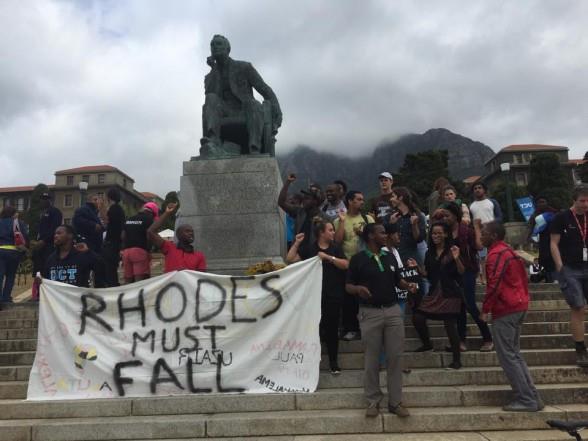
According to the conspiracy theory that's been discussed at Kiwiblog this week, the history departments of universities in countries like Britain and New Zealand have been seized by hateful left-wing radicals determined to denigrate European peoples and their history. Kiwibloggers have been upset by the Rhodes Must Fall campaign, which has seen students at Cape Town and Oxford universities demanding the removal of statues of the nineteenth century imperialist Cecil Rhodes from their campuses. According to the conspiracy theory being put about at Kiwiblog, both the Rhodes Must Fall campaigners and the men and women who teach history at New Zealand universities are determined to deny freedom of speech and thought to anyone who questions their anti-white prejudices. 
I think that this conspiracy theory just as flimsy as the claims about a coverup at Waipoua forest. 
Here are some excerpts from the exchanges I had at Kiwiblog. Apologies for the variable formatting... 
Jack5:
History departments have become PC-revisionist and more rigidly Leftist, while universities have added bullshit subjects such as PhD’s in social work. Scores of courses, including forensic science and kapihaka, while interesting, are conning youngsters into mountains of debt with no chance of work in the courses’ specific fields...
SH:
Do you read much of the work that New Zealand historians produce, and the New Zealand Journal of History? The journal has an online presence: take a look at the contents pages for the last few issues, and tell me when you think the rot set in. 

Sir Keith Sinclair's book The Origins of the Maori Wars would get him into trouble with many of the commenters at Kiwiblog. Sinclair was working on that classic in the 1950s, but historians of earlier generations could also be accused of political correctness. James Cowan’s magnificent History of the New Zealand Wars was written almost a century ago, but is not exactly sympathetic to the colonial government that invaded the Waikato Kingdom. John Gorst’s history of the Waikato War was published almost as soon as the war was over, and is resolutely hostile to that warmonger George Grey. I guess the rot set in very early.
Jack5:
It is student union activists (and largely foreign ones) who have been trying to force the university to take down a statue of Rhodes, for example. Student unions have become more Leftist, IMHO, because there are more bullshit courses such as the “social work PH.D.” Students are less likely to be doing courses related to their future jobs.
SH:
I don’t agree with the notion that arguments in favour of taking down a statue constitute an attack on freedom of speech. We exercise our freedom of speech when we debate whether statues should be raised or removed from public spaces. If a group of students blew up a statue then they might be accused of attacking free speech, but I don't think the Oxfordians have done that. 
Some of Rhodes’ left-leaning defenders, like the witty classicist Mary Beard, have argued that old statues ought to stand forever, even if they represent people who did bad things and are no longer esteemed, because old statues are a part of history. I do understand this argument, but I don’t think it should trump all others. I didn't notice any of Rhodes' defenders complaining when an enormous statue of Lenin was recently felled by the government of Ukraine.
Jack5:
Many of the problems come from a wave of historians later than Sinclair giving oral “history” equivalent value to written records. The very latest wave made their names with this. 
SH:
It’s curious how you can’t name any of the members of this ‘wave’. I think you’ll find that reckless use of oral history was very much a late Victorian and Edwardian habit, in the work of folks like Elsdon Best and Percy Smith, who were responsible for garbling various stories into the Moriori myth. A much more responsible use of oral history was made by James Cowan a generation later. There’s nothing new about the use of oral history in New Zealand. I’d say we’ve gotten better at it, and we’ve done so precisely because we’ve broken with the old habit of treating it as a mere substitute for or equivalent to text.
Jack5:
I forgot that Auckland academics had unlocked that secret written Maori language in which tribes recorded their history for the last 500 years, and this was the backup for their legends and oral history.
SH:
Well, you’re getting closer, Jack: at least you’ve named a place where these nefarious historians are at work. But who exactly are the historians at the University of Auckland who are misusing oral history?
Jack5:
For use of oral-history sources, best-known is Professor Dame Anne Salmond. On checking, I see that her training was as an anthropologist, but she is best known for her NZ historical books.
Another is Dame Judith Binney. Here’s a quote about her from the Encyclopedia of New Zealand blog Signposts:
Judith was thus a pioneer of new ways of looking at Māori history and of translating oral testimonies and tribal memories into the pages of powerful literature. Like Dame Ann Salmond, Judith Binney suggested that Pākehā women have perhaps more success in gaining the confidence of Māori informants than us male historians.
SH:

In all honesty, Jack, have you read either Anne Salmond or Judith Binney? Binney’s great achievement is that she does not treat oral history as a factual guide to the past, but rather as a guide to the way the past is interpreted by communities who experienced it. If you read Binney’s masterpiece Redemption Songs you’ll see her working through the various stories about the prophet and warrior Te Kooti doing extraordinary things, and asking what these stories say about the people who tell them. Binney never claims that Te Kooti actually teleported across the North Island, or rode a white horse straight up a cliff. She treats stories like these as symbolic interpretations of the past. To claim that Binney uncritically accepted the literal truth of every story she heard about the past is to misrepresent her egregiously. 
Anne Salmond does look to oral history for information about the past, but tests the stories she hears against textual records and other types of evidence. Hence in her book The Trial of the Cannibal Dog, about the journeys of Captain Cook through the Pacific, she puts the stories that were told about Cook on the islands he visited alongside the journals kept by Cook and some of his crew members. There’s an old story on the Tongan island of ‘Eua, a story I have heard myself, which says that Cook left horses and sheep behind when he sailed off. Salmond checks that against the writings, and writes that Cook indeed did leave stock on ‘Eua. Salmond's use of oral history is a very long way from the unsubstantiated guesswork of the Victorian and Edwardian ethnographers.
Jack5:
So now historians check their facts. Historians have come a long way, then...like General Douglas MacArthur, I’ll now declare victory and move on to the next island, leaving some hapless Aussies or Kiwis to clean up the remaining Japanese.
[Posted by Scott Hamilton]

Thursday, June 04, 2009

Twenty of the best; or, a bibliography for recovering pseudo-scholars

In recent months, especially, this blog has spent a dispiriting amount of space on the fanciful and malicious claims about New Zealand history advanced by pseudo-scholars like Gavin Menzies, Martin Doutre, Kerry Bolton, and Rosanne Hawarden. Whether they tout themselves as 'alternative researchers', 'astroarchaeologists', or - most laughable of all - 'independent historians', the pseudo-scholars have one thing in common: a contempt for the rigorous methods and peer-reviewed body of literature developed by generations of serious researchers into New Zealand society and history. It would be timely, I think, to celebrate this heritage of genuine scholarship, by compiling a list - or a set of lists - of some of the classic works produced by the human sciences in New Zealand.

The following list of twenty classic books is obviously subjective - it speaks of my own passions and research interests, as much as anything else - and it is premised on a definition of 'human sciences' broad and fuzzy enough to include literary criticism as well as fields like archaeology and linguistics, which are closer in their methodologies to the natural sciences. Post your criticisms and amendments in the comments box.

Perhaps this list could serve as a bibliography for any recovering pseudo-scholars reading this blog. I'm sure that nobody who reads Judith Binney or HD Skinner will ever want to go back to the ravings of Martin Doutre or Kerry Bolton.

Judith Binney, Redemption Songs: a life of Te Kooti Arikirangi Te Turuki , Auckland University Press, 1995.

The big one. Decades in the making, Binney's biography of the nineteenth century prophet, guerrilla leader, church founder, and songwriter is an epic in every sense of the word. Binney's narrative manages to draw on an astonishing array of written and oral sources, and to do justice to the frequent contradictions between these sources, without ever being anything less than compelling. The chapter explaining the book's methodology is of enormous value to any scholar concerned to honour both oral tradition and historical fact. By treating the myriad local traditions about Te Kooti - stories that describe his ability to travel vast distances in a moment, or ride his white horse up a cliff to escape capture, or make volcanoes erupt - as expressions of the relationships of different groups of people to the man, expressions which must be sensitively interpreted, rather than either taken literally or dismissed out of hand, Binney steers a path between the rocks of Eurocentrism and cultural relativism.

HD Skinner, The Morioris of the Chatham Islands, Honolulu, Hawaii, 1923.

HD Skinner was the founder of modern archaeology in New Zealand, and this book helped establish his reputation. He'd been desperate to see the Chathams for years, but war service and then petty bureaucratic regulations thwarted him, until he was driven to tuck some mince pies into his overcoat and stow away on a boat leaving Lyttleton for the islands. Skinner eventually returned to the Chathams with a team of students, and his thoroughgoing examination of skeletal evidence, tree and rock carvings, artefacts, and oral tradition demolished the pernicious myth that the Moriori were a Melanesian people who had been driven from the North and South Islands by the ancestors of the Maori. If only the myth had died as quickly amongst the general public as it did amongst scholars. David Bedggood, Rich and Poor in New Zealand: a critique of class, politics, and ideology, Allen and Unwin, 1980.

It may be hard to imagine now, but thirty years ago 'class' was a forbidden word for many scholars of New Zealand society. Along with an important anthology of writing on Social Class in New Zealand edited by David Pitt, Bedggood's Rich and Poor in New Zealand helped make the dirty word an acceptable part of the discourse of social scientists. Keith Sinclair gave both books very bad reviews, denying that classes existed in New Zealand and protesting that Bedggood had not bothered to do any research in an archive. Bedggood has never been much of a man for archives: he is interested in broad social trends, and in what Marx called the 'laws of motion of capital', rather than in historical detail. Rich and Poor in New Zealand is a sweeping, acerbic history of this country which emphasises the brutality of colonisation, the reality of yawning gaps in income and opportunity between different classes, and the persistence of industrial conflict. Thirty years after it was written, the book still figures on reading lists given to undergradute sociology students at New Zealand universities.

Geoff Park, Uruora: the Groves of Life , Victoria University Press, 1995.

Geoff Park's book is the record of a series of journeys in search of New Zealand's mostly-vanished lowland forests. As he crosses sodden dairy farms, kayaks down weed-infested drainage ditches, and inspects crumbling middens, Park meditates on the ways in which European colonists sought to impose a 'Cartesian' order of straight lines and clearly demarcated 'natural' and 'inhabited' zones on the landscape they found in New Zealand. Park is a superb prose stylist, and his chapters are rich in references to philosophy, archaeology, and history, as well as botany. When he does discover surviving stretches of lowland forest in areas like Mokau and the northern West Coast, Park's writing becomes rhapsodic, in the best sense of the word.

Park is a conservationist, but he is critical of the tendency of many environmentalists to want to 'quarantine' supposedly 'virgin' parts of nature in 'scenic reserves'. He rightly points out that the whole notion of 'virgin nature' is a corollary of the industrial revolution, which divided humans from the natural world in unprecedented ways. Park laments the way in which the establishment of scenic reserves often led in the early twentieth century to the displacement of Maori, who had learned to live inside and with 'virgin nature' in a way which conservationists did not understand.

Miles Fairburn, Nearly Out of Heart and Hope: the puzzle of a colonial labourer's diary, Auckland University Press, 1995.

Fairburn has a knack for combining microhistorical detail with historiographical speculation, so it is not surprising that his close reading of the diary of an impoverished labourer who wandered the backblocks of the lower North Island in the early twentieth century becomes an investigation into the causes of working class conservatism. Why did a man who suffered continually from the shortcomings of capitalism retain his belief in the hoary maxims of 'hard work and self-reliance', instead of identifying with the militant socialism that was a force in New Zealand in the first decades of the twentieth century? After an extraordinarily sensitive reading of his source material, Fairburn offers a convincing answer.

Judith Binney, The Legacy of Guilt, Auckland University Press, 1968.

Binney's first book does not have the narrative smoothness or the scope of Redemption Songs, but it is nevertheless an insightful treatment of the much-mythologised story of Thomas Kendall, the early missionary who 'went native' after becoming engrossed in the study of the Maori language and religion.

Dick Scott, Would a Good Man Die? Niue, New Zealand, and the late Mr Larsen. Southern Cross Books, 1993.

Dick Scott may be better known for his polemical histories of Parihaka and the 1951 lockout, but his study of the venal and brutal colonial regime that a police officer from a provincial New Zealand town established in mid-century Niue also packs a punch.

Len Richardson, Coal, Class and Community: the united mineworkers of New Zealand, 1880-1960. Auckland University Press, 1995.

Richardson wears his heart on his sleeve, but this study of one of New Zealand's most militant unions is much more than a celebration of battles won and a lament for battles lost. Richardson is attentive to cultural as well as political history, and his book includes fascinating details of miners' leisure time activities, as well as the time they spent down the pit and on the picket line. Today's postgraduate students should be made to read Richardson's account of how many West Coast miners would go straight from a ten-hour shift down the pit to an unheated 'study hut' where volumes of Marx waited.

Ian Richards, To Bed at Noon: the life and art of Maurice Duggan, Auckland University Press, 1997.

In Richards' sure hands, the truncated life of a minor New Zealand writer becomes a rich picture of Auckland in the middle decades of the twentieth century. Richards shows us the tight, working class Catholic community in which Duggan grew up, and then the even tighter Bohemian North Shore community which he entered after suffering a freak misfortune, before following his hero into Auckland's corporate world and its mental hospitals. Richards is currently living in Japan, but he is still turning out superb pieces of literary history, as this essay on Kendrick Smithyman's fear of flying shows. Nga Patai: racism and ethnic relations in Aotearoa/New Zealand, various, ed. Paul Spoonley, David Pearson, Cluny Macpherson, Dunmore Press, 1996.

If Nga Patai were more widely read our race relations would be in better shape. Almost every entry in this anthology is worth reading, but Evan Poata Smith's argument that Maori nationalism will become a political dead end if it does not take notice of class as well as ethnicity is particularly pertinent today.

Paul Spoonley, The Politics of Nostalgia, Dunmore Press, 1987

I'm obliged to mention this book, because I cited it religiously in the talk I gave on New Zealand's anti-semites for National Radio the other day. Spoonley's study of the strange flora and fauna of the extreme right - what other part of the political spectrum could give its organisations names like Zenith Applied Philosophy and the Church of Odin? - is distinguished by the connections it makes between ideology and class. Spoonley's discussion of the rural petty bourgeois basis of paranoid anti-semitic groups like the League of Rights is particularly impressive.

PW Hohepa, A Maori Community in Northland, Reed, 1970.

Hohepa's book is one of the first detailed anthropological studies of a Maori community conducted by a member of that community. Using his professional skills and deep 'inside' knowledge, Hohepa introduces us to a group of people who have inhabited a lush but isolated valley in the upper Hokianga for many hundreds of years, and who have in that time developed their own intricately beautiful culture.

Roger Neich, Painted Histories: early Maori figurative painting, Auckland University Press, 1993.

Neich's massive and sumptuous book honours a series of paintings that were for a long time considered grotesque symptoms of cultural decline. Often intricate and brightly-coloured, the paintings which adorn the meeting houses associated with Te Kooti's Ringatu movement fuse elements of the symbolic, stylised art of 'classical' Maori society with the realistic, sometimes jocular artforms of nineteenth century British culture. The result might almost be called New Zealand's first bicultural art. No wonder the Victorians were upset.

Christina Jefferson, Dendroglyphs of the Chatham Islands: Moriori designs on karaka trees, Polynesian Society, 1956.

Jefferson did not get a very friendly welcome when she appeared on the Chathams shortly after World War Two and began to ask questions about the carvings Moriori had made on trees. Refusing to believe locals' claims that the carvings had all but disppeared, and would not have been worth studying anyway, Jefferson hopped on a sturdy horse and spent months travelling Chatham and Pitt Islands, camping amidst the groves of karaka she searched for dendroglyphs. The hundreds of charcoal drawings of carvings which Jefferson published in 1956 have aesthetic as well as anthropological value. Jefferson's role in preserving the heritage of the Chathams has been recognised by subsequent scholars, yet she never published again.

James Belich, The Victorian Interpretation of Racial Conflict, Queens University Press, 1986.

Belich would later gain acclaim for his detailed studies of half-forgotten primary material relating to New Zealand's military history, but in this early piece of research he focuses on reinterpreting well-known facts about the wars between Maori and Pakeha. In a series of exemplary arguments, he shows that Victorian commentators were prevented from recognising the military achievements of Maori by notions of racial superiority. When they pondered the very slow advance of General Cameron's British army into the Waikato Kingdom in 1863, for example, they tended to blame Cameron for being over-cautious or incompetent, instead of recognising that well-organised attacks by Maori guerrilla forces to the north of the Waikato were seriously compromising British supply lines.

The Origins of the first New Zealanders, various, ed. Doug Sutton, Auckland University Press, 1994.

A triumph of interdisciplinary cooperation, this collection brings together anthropologists, historians, linguists, and boatbuilders to suggest answers to an old question. The most remarkable contribution comes from linguist Ray Harlow, whose analyses of the differences between a variety of Maori dialects leads him to suggest that New Zealand was settled by several distinct groups of Polynesians. Harlow has since extended his research by analysing the speech of various members of the Maori battalion who recorded greetings to their whanau while they were stationed in North Africa in World War Two. Because the differences between the dialects of iwi were more pronounced in the 1940s, Harlow hopes these crackly recordings from the deserts of Libya and Egypt can provide new insights into the prehistory of Aotearoa.

Kai Jensen, Whole Men: the masculine tradition in New Zealand literature, Auckland University Press, 1996.

In the fascinating introduction to this neglected book, Jensen explains that he became a radical feminist in the 1980s, and enrolled as a PhD student at the University of Auckland because he wanted to expose the patriachal nature of traditional New Zealand literature. During the seven years it took him to finish his thesis, though, Jensen lost some of his polemical zeal, as he became immersed in the postmodern theories of Derrida and Foucault that were washing through the university's English department. The result of Jensen's labours is a book which is sensitive to the 'gendered' nature of much of the writing of Kiwi literary legends like Dennis Glover and Allen Curnow, yet generously understanding of the historical and social situations which determined what those writers produced. Jensen's smooth prose and aversion to unnecessary jargon should be examples to all our literary scholars.

James McNeish, The Mask of Sanity: the Bain Murders, David Ling Publishing, 1997.

Some of you will no doubt baulk at the inclusion of this book in my list, but I think that its combination of detailed reporting, historical reconstruction, and pyschological portraiture distinguish it from the sensationalism and special pleading that have marked most accounts of the Bain saga. I hope that the long-suffering jurors in Christchurch have been reading McNeish's book on the sly.

Harry Orsman, Reed Dictionary of New Zealand English, Reed, 2001.

I've always thought that Orsman's marvellous, meticulously-assembled inventory of 'New Zild' was really a cryptic epic poem of the sort that Richard Taylor or Louis Zukofsky might produce. John Reynolds evidently agrees with me that Orsman's book is the stuff of art - in a massive work that almost won last year's Walters Prize, he scattered seven thousand entries from the dictionary across the walls of two levels of Auckland's New Gallery. Danny Keenan, Wars Without End, Penguin, 2009.

The anonymous smart-alec commenter who was giving me grief last week for talking of New Zealand's nineteenth-century 'Land Wars' ought to consult Maori historian Danny Keenan's fine new book. In his first chapter, Keenan casts his eye over the bewildering variety of names the conflicts between Maori and Pakeha have been given, uncovers the political motivations behind these names, and settles for Land Wars, on the grounds that all the diverse causes of the conflicts were concentrated in the issue of land ownership. It's a very good start to a very good book.

Tuesday, May 15, 2018

A top twenty

Steve Braunias recently sent me and a bunch of other New Zealand scribblers a list of the hundreds of titles that have won national book awards over the past fifty years. He asked each of us a to choose a top twenty from the list, and then compiled our choices into a top fifty for the The Spinoff Review of Books. This is the list I sent to Braunias. 


Judith Binney, Redemption Songs (1996) 
Our Homeric epic. Binney's life of Te Kooti is inexhaustible, and turns its protagonist into a figure as wily and unkillable as Ulysses. 
Michael King, Moriori: a people rediscovered (1990)
Not many books have helped rescue a people from oblivion: this one did. 
Anne Salmond, Trial of the Cannibal Dog (2004) 
Salmond's years of research on Polynesian outliers, where the sound of the sea is constant and the rest of the world consists of a series of visiting ships, gives her account of Cook's voyages and landfalls a veracity that no library-bound scholar could achieve.
Michael Jackson, Pieces of Music (1995)
Jackson is a forgotten man in New Zealand, but an honoured scholar and writer overseas. This series of prose poems shows a young man with a head full of Camus and Apollinaire floating through postwar New Zealand.
MK Joseph, The Time of Achamoth (1978) 
Time travel stations hidden in the King Country, visits to the Paris Commune and a future dystopia, a fight with a monster living in Karl Marx's grave: what more can a novel offer? The Time of Achamoth is a neglected masterpiece.
CK Stead, Smith's Dream (1972)  
A rewrite of Mulgan's Man Alone by a young man obsessed with apocalypse. Smith's Dream has haunted Stead: he wrote it quickly, so quickly he might have been taking dictation, and he knows that the painstaking and overstuffed novels he has created in recent decades have lacked the power and precision of his debut.  
Nga Iwi o Tainui, ed. Rei Te Hurihuri Jones and Bruce Biggs (1989)
An extraordinary arsenal of images and symbols and stories, wrought from the oral tradition of a great and greatly
wronged iwi. 
Michael King, Te Puea (1978)
A book that introduced the Pakeha world to the monarchy on their doorstep and the Maori civil rights movements of the twentieth century.
Martin Edmond, The Autobiography of My Father (1990)
Edmond reinvented creative non-fiction with a magnificent sequence of books in the '90s and early 2000s. This isn't his best book - he was still learning how to link anecdote to anecdote, still apologising for the dreams and hallucinations he would later treat as revelations - but it'll do. 
Douglas Wright, Ghost Dance (2008)
Wright's prose is so exact and sensual that he manages to make the ugliness of his illness strangely erotic.
Dick Scott, Seven Lives on Salt River (1989)
A regionalist masterpiece, and a rebuke to urbanites who disregard the history of places like the Kaipara. 
Albert Wendt, Leaves of the Banyan Tree (1980)
A huge book that shows Wendt's extraordinary ambition and energy. 
Kendrick Smithyman, Stories About Wooden Keyboards (1985)
The sly old fox of New Zealand verse. I published a book about him; of course I'm going to nominate him. 
Judith Binney and Gillian Chaplin, Nga Morehu (1987)
Judith Binney made oral history respectable again in the academy, after long decades when it was shunned. The ghost of James Cowan must have been happy. 
Frank McKay, The Life of James K Baxter (1991)
McKay's conservatism and tepid tone makes his account of a hellraiser's life unintentional funny. When he deals with the Baxter crew's orgies and drug-taking McKay resembles a Presbyterian vicar tiptoeing past a brothel. 
Janet Charman, Cold Snack (2008) 
Charman is a schoolteacher from Avondale. She writes what she sees in tight, truncated lines that build steadily in intensity. 
Allen Curnow, An Incorrigible Music (1980)
Curnow may have resembled a pipe-smoking, cardigan-wearing professor, and the academic industry may be doing its best to make him safe and presentable, but make no mistake: he was a dark magus. Curnow's death-obsessed imagination finds its perfect subject in 'Moro Assassinato', a long, bloodthirsty, brilliant poem that begins in the waves of Karekare and moves to Italy, where the Red Brigades kidnap and slay the country's top politician. 
Tony Simpson, The Sugarbag Years (1974) 
By the seventies, Depression-era New Zealand seemed like a lost civilisation, a brutal and impoverished place that had been determinedly forgotten. Simpson explored the ruins of remote work camps, and excavated stories of suffering and rebellion from old men and women. 
Michelle Leggott, Dia (1994)
Leggott's book upset all the right reviewers, who complained they couldn't understand her poems. As Wallace Stevens said, though, great poetry communicates before it is understood. 
Sam Sampson, Everything Talks (2009) 
Sampson is an unrepentant avant-gardist, a spinner of Joycean word games, an enemy of linear thought and full stops. He remains holed up in the Waitakeres, where he takes inspiration from the rune-like patterns flying ducks and kereru make on the evening sky.  

Friday, March 25, 2011

Crossing cultures

The internet is an excellent place in which to issue ringing denunciations, especially when your name is Anonymous. A particularly resonant denunciation was recently issued at the Hand Mirror blog, and I was perhaps one of its mysterious author's targets:

Just remember, pakeha, that while it's your duty to learn about Maori culture no matter how much you learn you will never truly understand it because ITS NOT YOURS.

Makes me sick to see pakeha people telling Maori people "Oh yes I understand Maori tradition, I understand Maori culture". No, you don't. You can watch it and learn about it but you can never understand it because you are not part of the tangata whenua.

Learning is good if it empowers indigenous people. But too often "learning" about Maori culture is just a way for pakeha people to claim they don't need to empower indigenous people because they "understand" their culture.


I wouldn't want to disagree entirely, or even mostly, with this statement. I believe that there are regions of Maori culture - of every culture - which are special, and which are inaccessible to outsiders, or else only accessible to very careful outsiders. But there are also many places where different cultures overlap or collide, and where dialogue and borrowing are not only possible but inevitable.

In an archive where I have done some research lately there are a few unpublished letters written by the nineteenth century prophet and guerrilla leader Te Kooti, and an unpublished diary kept by the twentieth century Waikato heroine Princess Te Puea.

I think these documents must be fascinating, and if they were published and translated by someone else I would read them with great interest, but I've never ordered them up from the vaults and looked at them myself, even though access to them is not restricted.

I think that to handle materials like Te Kooti's letters and Te Puea's writings one would need to be immersed in the history and culture of Te Kooti's Ringatu Church and Te Puea's Kingitanga movement respectively. There's a level of background knowledge required which could be gained only by living inside those 'worlds', either as a result of being born into them or making a meticulous entry into them.

I don't think it would be impossible for a Pakeha scholar to handle the texts - certainly, Judith Binney, the sadly missed biographer of Te Kooti and historian of Tuhoe, seemed to deal pretty well with a lot of Maori written and oral material - but they're not something which any Pakeha could pick up and handle without arduous preparation.

I'd make a distinction between Te Kooti's sacred writings and, say, some of the key events of his life. These events - battles, peace marches, flights into exile, returns from exile - are well-known, and are part of the history of Pakeha as well as Maori New Zealanders. Many writers, Pakeha as well as Maori, have been inspired to write about Te Kooti, so that he has become a character in poems, songs, and at least one novel, Maurice Shadbolt's popular Season of the Jew.

I would argue that Te Kooti has become, in a sense, a mythopoetic figure, like Odysseus or Alexander the Great, and that his deeds can resonate imaginatively across distant cultures.

The unashamedly Pakeha Kendrick Smithyman wrote some important poems about different aspects of Te Kooti's life: he composed one about a visit to Te Porere, the last battle pa Te Kooti built, and another about Te Kooti's strangely amicable last meeting with Gilbert Mair, the Pakeha commander who had chased round the North Island for years. Smithyman's poems aren't attempts to steal Te Kooti, or to 'write like a Maori': they are attempts to set up a dialogue between Pakeha and Maori history and thought.

When Judith Binney came to write her biography of Te Kooti, she included, as one of her appendices, a selection of songs and poems that Pakeha writers like Smithyman had produced about Te Kooti. She argued that these texts have become a part of the traditions which surround Te Kooti.

Before anyone criticises the Pakeha writers who have made Te Kooti into a subject, they ought to remember that Te Kooti himself was a great investigator of and borrower from other cultural traditions. He took the Old Testament and reinterpreted it in a Maori light, making his people into 'Jews'; he took the European tradition of realistic figurative painting and put it inside the extraordinary meeting houses that the Ringatu Church raised in his honour.

The sort of complex interplay between cultures which Te Kooti and Smithyman in their different ways practiced mocks attempts to put up 'off limits - no entry' signs around one or another culture and history.

As a sort of feeble salute to cross-cultural artistic inspiration, and as an admission that I suffer from what Osip Mandelstam called 'a homesickness for world culture', I wanted to post a poem which recently managed to annoy that distinguished scholar of classical Greek culture, Ted Jenner. After I sent him the poem, my long-suffering friend complained that I'd needlessly pulled not only Homer and Odysseus but his hero, the mysterious pre-Socratic philosopher Heraclitus, out of their properly European context, and placed them in the South Pacific.

My problem, Ted, is that my imagination keeps putting Odysseus in Tonga, not in the Mediterranean, and insists on Heraclitus as a boozy Greek-cum-Aussie fisherman, not some ancient and irretrievable mystic.

Anonymous polemicists should be feel free to use the comments box under this post.

Homer and Heraclitus

Say that Homer and Heraclitus are getting blind drunk
on a bottle of ouzo, in the back room of a cheap Greek
restaurant, on Lonsdale Street, sometime in the fifties,
before the smell of fish got washed out
of the gutters, before the Melbourne cops
stopped taking bribes, before tourists
chased the gangsters away.

Say that Homer went blind
transcribing and revising his poems
after mass literacy made his recitals
obsolete.

Say that Heraclitus lost his eyes
on an Arctic trawler,
after the crew ran out of vodka
and cracked open the meths.
(Say that it hardly seemed to matter,
in the middle of a winter-long night.
At least the dark was warm, after half a glass.)

Say that poet and philosopher
deserve their private room, and their booze.
Neither will see out the summer.
(Say that Homer moves down Lonsdale at the speed
of a walking frame, that Heraclitus smells
like the inside
of a colostomy bag.)

Do the blind old men
toast their health?
Do they reach out
across the table,
listening to the half-melted cubes
knocking together (like smooth-cornered dice
in an old gambler's cup?)
then wait for their frosted glasses
to clink politely, or to strike
a single, sharp note,
or to grind against each other
like floes of ice?

Never mind. In Ithaca, or some other piece
of Polynesia, Ulysses has just tethered his listing ship
to a banyan tree, left his comrades to their duty-free booze,
and headed uphill, through an overgrown plantation,
toward the pou and the kumara beds
of the papakainga. Say that he is filled with space and time.

Saturday, March 17, 2012

Excalibur Downunder

Last year I mentioned Gregor McLennan's claim that Blairism is not so much a coherent set of beliefs as a 'vehicular ideology', made up of callow concepts and improvised slogans which are abandoned as soon as they have served some brief rhetorical purpose.

David Shearer's first major speech as leader of the Labour Party marked him as a vehicular ideologist par excellence. Moving relentlessly from soundbite to soundbite, Shearer showed a thoroughly Blairite contempt for linear argument and empirical proof.

The Dim Post blog has been hosting a less-than-earnest discussion of the following sentences, which constitute perhaps the strangest piece of rhetorical debris in Shearer's speech:

A vision is a marvellous thing, but it’s a bit like Excalibur. You have to know what you’re doing with it.

Excalibur, of course, is the magical sword wielded by the once-and-future King Arthur in the set of legends which were created in the confusion of pre-Norman Britain, and which today continue to inspire painters, writers, and dodgy auteurs around the world. In the early written versions of the the legend Arthur is gifted Excalibur by a mysterious character known as the Lady of the Lake, but since at least the nineteenth century storytellers have often depicted him drawing the sword from a stone. Shearer's use of Arthurian imagery may seem eccentric, but there have been earlier local incarnations of the Excalibur myth.

As every cricket fan who grew up in the 1980s knows, Lance Cairns’ bat bore the name of Arthur’s weapon. Cairns was a barrel-chested swing bowler who batted at number nine in the Kiwi order and liked to play short explosive innings. After Cairns' sword of willow smote an Australian pace attack led by Dennis Lillee for six sixes at the Melbourne Cricket Ground at the end of the 1982/83 season, the Mad Butcher arranged for it to be displayed in the window of one of his South Auckland stores. I have a vague memory of standing on tiptoes and squinting through glass smudged by the breath of a crowd at the sacred relic lying between strips of sirloin steak and piles of sausages. Excalibur was, I noticed, thinner than most cricket blades. With its shaven shoulders, it certainly looked more like a sword than the Grey Nichols bats used by many other members of the Kiwi cricket team.

Towards the end of Redemption Songs, her massive and magnificent biography of the nineteenth century prophet, writer, hermeneuticist, and guerrilla warrior Te Kooti Arikirangi Te Turuki, Judith Binney discusses another, rather more profound local adaption of the Excalibur story.

Binney describes how, after finally being pardoned by the Pakeha government which had pursued him through the forests and mountains of Te Ika a Maui for four years and then isolated him for another decade or so, the elderly Te Kooti decided to attempt a visit to his hometown of Turanga/Gisborne. The prophet had renounced violence and dedicated himself to spreading the gospel of his Ringatu church, but Gisbornians were nevertheless nervous about the prospect of his return to their town. The last time the prophet had visited, on November the 10th, 1868, he and his disciples had executed fifty-four locals. The raid was intended as revenge for Te Kooti's imprisonment without trial on the Chathams and the theft of some land he co-owned, but most of its victims had nothing to do with these injustices.

Twenty-one years later, Te Kooti had not been forgiven. While the prophet rode towards Turanga with scores of his followers, stopping along the way at favourite taverns, the citizens of what was now a majority Pakeha town improvised a militia, and trotted off to confront him. Te Kooti was prevented from entering central Gisborne, but before his arrest he did make it as far as Makaraka, near the southwest edge of the town, where roads heading south into the Hawkes Bay and east into the Poverty Bay hill country intersect.

According to a Ringatu story which Binney relates, as Te Kooti stood at the Makaraka crossroads his walking stick suddenly began to sink into the ground. It disappeared, and continued to fall until it lay some distance from the surface of the earth. As he observed this event, which was only the latest in a lengthy series of supernatural interventions in his life, Te Kooti is supposed to have said something like “There will be peace in New Zealand as long as my sword remains in the earth”.

The most famous claimant to Te Kooti's prophetic mantle offered up his own adaption of the Excalibur story. When he announced in 1905 that he was the new prophet the dying Te Kooti had predicted, Rua Kenana claimed that he had climbed Maungapohatu, the sacred mountain in the heart of the rohe of Tuhoe, and found on its peak a huge diamond. Rua added that he had successfully removed this rock from the mountaintop, then returned it safely to its resting place. He argued that by drawing the diamond from the mountain he had proved himself the the successor to Te Kooti.

The Arthurian myths became very popular in nineteenth century Britain, because they seemed to endow the country's rapidly expanding empire with a deep history and a certain gravitas. It is not surprising that Te Kooti and his followers would appropriate an element of Arthurian romance to suit their needs, in the same way that they had appropriated and reinterpreted the Bible, and especially the mythology of the Old Testament.

We can't, sadly, expect the same sort of systematic assimilation of ideas and symbols from David Shearer: like all good exponents of vehicular ideology, he flourishes a slogan or an image only to abandon it in haste.

[Posted by Maps/Scott]

Saturday, February 27, 2016

Who speaks for Ruatoria?

A couple of weeks ago I included Ngati Dread, Angus Gillies' three volume account of the murderous clashes between Rastafarians, conservative farmers, and cops in 1980s Ruatoria, in my list of great New Zealand works of non-fiction. 

Ngati Dread took a decade to research, and includes long, often unexpurgated interviews with numerous survivors of the violence of the '80s, as well as many pages lifted from court transcripts. 

Steve Braunias read Ngati Dread, and was excited enough to celebrate it over at The Spinoff. Braunias did a long and fascinating interview with Gillies, commissioned a review of Ngati Dread by Talia Marshall, and ran an excerpt from the book's first volume. 


As Braunias concedes in a new post at The Spinoff, though, not everyone shares his enthusiasm for Ngati Dread. In a series of messages to Braunias, the Ruatorian Kiri Dell questioned Gillies' probity and prose style, complaining that:


Clearly this whole thing lacks a concern about people and is a focus on book sales...This is not your story to tell, it is our story. These books are terribly written and the interview skills weak, bias and leading...Why do white people write about us? Ask yourself Angus, who are you serving by writing these books? 


Braunias had commissioned a piece about twenty-first century Ruatoria, but its unnamed author got cold feet, explaining that: 


I've seen a range of reactions from locals to the Angus interview, some negative but some less so. I'm not sure it's culturally insensitive - just basic human dignity insensitive and unethical, it's really no one else's story to tell, so if the community doesn't want to tell it, then leave it alone until they are ready to share it - or not.  


Here's a comment that I left at The Spinoff: 


According to the anonymous writer who withdrew a piece from The Spinoff, the story of the Rasta uprising of the 1980s should only be told when 'the community' of Ruatoria and surrounding areas is 'ready' to tell it. According to Kiri Dell, the Ruatoria community should be able to be able to tell its own story, 'in its own words' and from 'its own eyes'. 


Both of these comments imply that the community of Ruatoria has a single perspective on the past, and a single way of talking about that past. Both commenters suggest that, simply because some inhabitants of the area disagree with what Angus Gillies has written in Ngati Dread, Gillies' book must be untruthful and his methods unethical. 


What Ngati Dread and other accounts of the Rasta uprising of the 1980s surely show us, though, is that Ruatoria in particular and the East Coast in general are not communities whose people think alike, but rather sites of long-running conflict. 


The Rasta uprising was a conflict inside Ngati Porou, as much as between Maori and Pakeha. As Angus Gillies notes in his interview with The Spinoff, the leader of the Rastafarians was killed by his own cousin. 


When they hailed Te Kooti as a prophet of their religion, the Rastas invoked the memory of the Ngati Porou civil war of 1865-66, which saw adherents of the anti-colonial Pai Marire faith defeated by a conservative faction of the iwi intent on making alliances with the colonial government and the British Empire. Te Kooti became identified with the Pai Marire rebels, and began his own war against Ngati Porou's conservatives after escaping from the Chatham Islands, where he had been imprisoned with other rebels. 


In the twentieth century conservative leaders of Ngati Porou like Apirana Ngata had immense influence over government policy toward Maori. They worked to stymie new rebels against colonial authority, like Rua Kenana in the Ureweras. Only a decade ago Ngati Porou's leaders helped to weaken the pan-iwi movement against Labour's seabed and foreshore legislation by making a deal with the government. 


The Rastafarian movement can be considered, in part, as a renewal of the nineteenth century revolts against Ngati Porou's leaders. It is significant that some of the mentors of the movement, like Sue Nikora, have been involved in the attempts of dissatisfied hapu to secede from Ngati Porou. In Potaka and around the East Cape, near the edges of Ngati Porou authority, rebellious hapu have over the last decade declared their independence not only from the iwi leadership but from the state of New Zealand. These rebels have made their own Treaty claims. 


Given their place in a long and continuing history of conflict, is it really reasonable to expect that the events of the 1980s would be interpreted in a single way by the Ruatoria community? Do other communities with a history of conflict view and discuss their history without disagreement? 

The list of fifty great books about Maori compiled for The Spinoff by Te Roopu Haututu included Redemption Songs, Judith Binney's epic biography of Te Kooti, and Michael King's famous account of the life of Princess Te Puea. But when Redemption Songs was published twenty years ago it was received with anger as well as acclaim, because Maori as well as Pakeha descendants of some of the victims of Te Kooti's military campaigns considered that Binney had been too sympathetic to her subject. And although King's portrait was admired by many supporters of the Kingitanga, some of the hapu of the lower Waikato were very upset by the historian's decision to take the side of Te Puea against their more conservative, pro-Crown ancestors. 

It is not only in Maori communities that conflict over the interpretation of the past persists. I grew up in Franklin, down the road from the farms of the Crewe and Thomas families, and remember the bewilderment and anger that the murder of the Crewes and police frame-up of Arthur Alan Thomas caused in a small and conservative rural community. 

Steve Braunias discusses the murders and their psychic effects in a chapter of his book Civilisation. I admired the chapter, and showed it to my mother. She liked it too, but another local disliked Braunias' tone and assertions. The different opinions of Braunias' text did not surprise me: Franklin is still divided by the Crewe killings, with different families favouring different theories about the event, and the families of the cops who framed Thomas still trying quixotically to rehabilitate their kin. None of the many books about the Crewe murders has been received with unanimity in Franklin.

If the rules that Kiri Dell and the anonymous would-be writer for The Spinoff suggest were adopted, then the writing of history would become impossible. No community speaks with one voice, and interprets its past in one way.


[Posted by Scott Hamilton]